
Rockbridge Release Date Types
A scheduled or projected release date is a calculation made before custody ends. It reflects the sentence and the facts known to the calculating authority at that time. An actual release date records the completed event. The two may match, but they do not prove the same thing. A future date should never be reported as though the person has already left custody.
Virginia records also distinguish an advance notification from an actual-release notice. Advance notice says the event is expected. A VADOC Order of Release, notification-of-release letter, or completed custody record documents the later action. Rockbridge Regional Jail uses its own local movement and release records. The VADOC state-facility release process does not set the regional jail’s release-hour policy.
| Date or record | Meaning | Limit |
|---|---|---|
| Projected or expected date | Current sentence computation | Can change before release |
| Advance release notice | Release is anticipated | Not proof of physical exit |
| Court order date | Judge acted in that case | Other holds and processing may remain |
| Actual release date | Custodian recorded the completed movement | Destination still determines release versus transfer |
Important: A date passing without a custody-status change is a reason to contact the custodian, not a reason to declare release.
Find a Rockbridge Release Date
Begin with the custody system. Rockbridge Regional Jail is the local path for pretrial detention, short local terms, and some people awaiting VADOC movement. The VADOC locator and time-computation office cover state authority. BOP handles sentenced federal custody. A court record supplies the legal sentence or order but does not always show the final administrative calculation.
- Identify the present custodian and the court locality. Rockbridge Regional Jail also serves Lexington and Buena Vista.
- Decide whether the person is pretrial, serving a local sentence, serving state time, or in federal custody.
- For local custody, call 540-464-1188 and request the existing booking, sentence, time-computation, or release record that answers the question.
- For state custody, search the VADOC locator by name or seven-digit DOC number and read only the date wording actually displayed.
- Check the sentencing court for the judgment, active term, jail-credit order, later correction, and any release-related order.
- After the event, replace the estimate with the custodian’s actual release record and destination.
The Rockbridge County released inmates home page explains the full released-person search when the issue is whether someone already left custody. The date workflow here remains focused on the calculation and the records that confirm it.
Note: A court sentence and a custody date are linked, but the calculating authority must apply credits, overlapping terms, and later orders.
Rockbridge Pretrial Release Dates
A pretrial detainee has not begun a final sentence in the pending case. There may be no fixed release date. The next meaningful event could be a bond hearing, execution of bond, recognizance release, dismissal, plea, trial, or a new order. A docket date is usually a court date, not a promise that the jail will release the person that day.
Check Lexington/Rockbridge General District Court for misdemeanors, traffic-criminal matters, and preliminary felony stages. Rockbridge Circuit Court holds felony judgments, circuit sentences, and appeals. A felony may have related entries at both levels. Because the regional jail serves three localities, verify the arresting agency and case locality before searching.
A bond grant can be followed by conditions, bond execution, identity checks, other warrants, or a detainer. The court order proves the legal action in that case. The Rockbridge Regional Jail movement entry proves when the person left that facility and whether the destination was the community or another custodian.
VADOC Rockbridge Date Lookup
The VADOC Inmate and Supervisee Locator covers state prisoners and active state supervisees. Search with at least the first three letters of the first name and the full last name, or use the seven-digit DOC ID. Location, race, gender, and age range are optional filters. VADOC states that the data updates daily and may be inaccurate or out of date.
The research did not verify the exact current public label for a future release date on a live result. Therefore, use the release-date field shown on the current result, if one appears, and copy its label word for word. Internal VADOC date terms must not be presented as public locator labels without a verified screen.
A result showing community supervision at District 12 supports release from secure state prison into VADOC supervision. A result that disappears does not prove a date or reason. The locator is not promised as a permanent historical archive after final discharge. Request the notification-of-release letter, Order of Release, or existing VADOC release entry for durable proof.
VADOC Time Computation Factors
VADOC says the calculating authority depends on the sentence type and active time. For a felony offense committed on or after January 1, 1995, earned sentence credits apply, and VADOC calculates release when the active earned-credit sentence exceeds twelve months. Pre-reception jail credit, the sentence type and total, earning-class levels, disciplinary offenses, and later computation events can affect the result.
The official VADOC Time Computation page identifies the agency route for calculation questions.
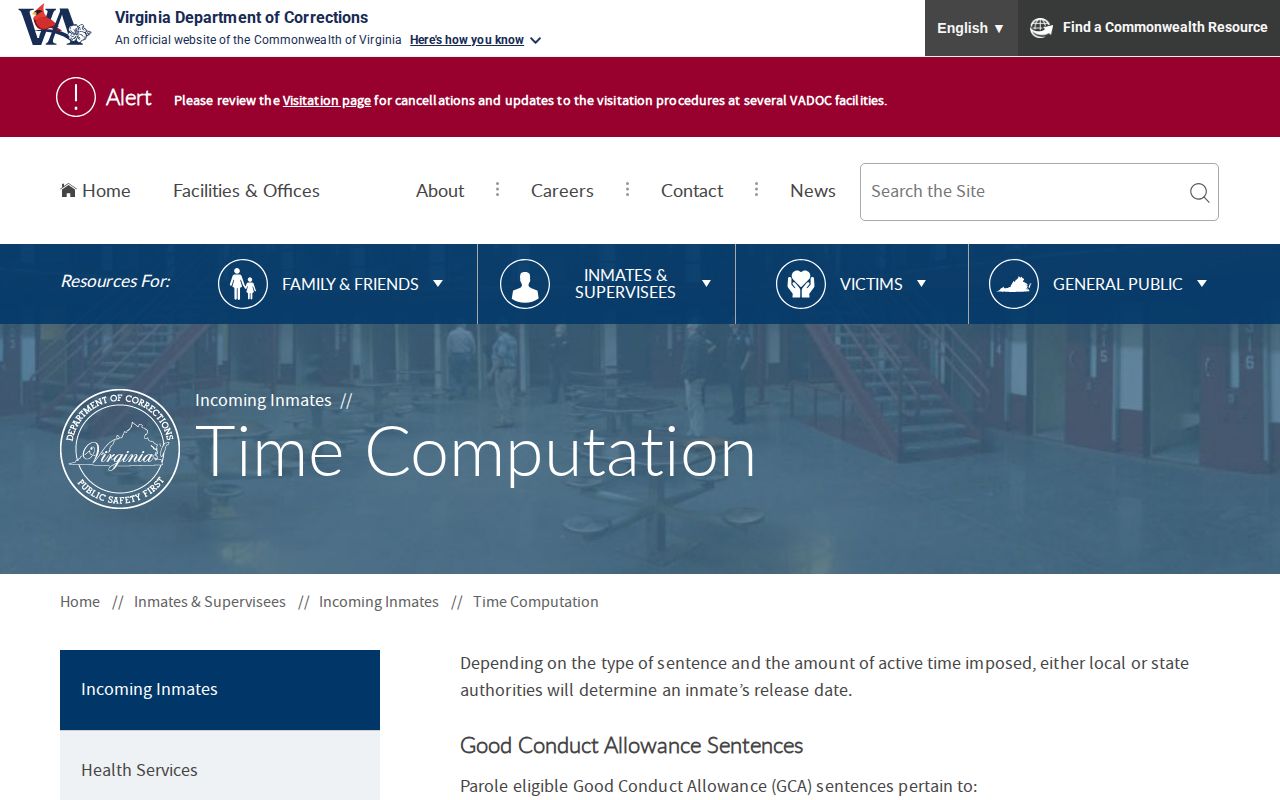
The screenshot supports the time-computation channel. It does not provide a person’s date without a matching record and sentence inputs.
Many state-responsible prisoners can remain in a local or regional jail while VADOC calculates time. The court supplies the sentence and jail credit. VADOC or the responsible jail applies those legal inputs. That division is why a court clerk should not be asked to predict the final corrections date.
Rockbridge Earned Sentence Credits
Virginia Code § 53.1-202.2 defines an earned sentence credit as a deduction from confinement and states that one credit equals one day. Section 53.1-202.3 sets rates and eligibility categories. The controlling offense and the law that applies to it must be identified before any rate is used.
For offenses listed in subsection A, the maximum is 4.5 credits per 30 days served. At that maximum, 30 days served satisfies 34.5 sentence days, or about 86.96 percent physical service. Virginia law does not impose one literal universal “85 percent” rule on every sentence. Using that phrase as a shortcut can produce a wrong release date.
For other eligible offenses, the current subsection B class structure can permit up to 15, 7.5, 3.5, or zero days of credit per 30 days served, depending on earning level and statutory or program terms. Credits can be reduced and levels can change. Amendments and future-effective versions make the current Code and controlling offense law essential.
Note: Earned credits reduce confinement under the governing scheme; they do not erase a detainer, another sentence, or a new court order.
Older Rockbridge Sentence Rules
Older parole-eligible sentences can use good-conduct allowance rules in Virginia Code §§ 53.1-198 through 53.1-202 and a mandatory-parole computation. Current earned sentence credits should not be applied to those cases without first identifying the governing scheme. Different schemes may also use different internal names for dates.
Virginia generally abolished discretionary parole for felony offenses committed on or after January 1, 1995, but § 53.1-165.1 contains current exceptions. Section 53.1-151 governs baseline eligibility for parole-eligible cases and contains special rules. A conviction year or sentence length by itself is not enough.
A Virginia Parole Board grant also is not an actual release date. Certification, acceptance of conditions, detainer checks, and administrative processing may follow. Use the Board decision for the authorization and VADOC records for the actual custody event.
Why Rockbridge Release Dates Change
A forecast changes when an input changes or a new legal constraint appears. The reason should be obtained from the authority that owns the affected record. The court explains a corrected sentence or jail-credit order. VADOC explains a state computation. Rockbridge Regional Jail explains a local movement or release entry.
| Change | Possible date effect | Best record |
|---|---|---|
| Jail credit correction | Moves credited service | Court order and time computation |
| Earned-credit level change | Speeds or slows projected service | VADOC computation record |
| Disciplinary offense | May reduce credits or delay release | Custodian’s disciplinary and computation record |
| New or corrected sentence | Changes total active time | Sentencing court order |
| Warrant or detainer | Can cause transfer instead of community release | Hold and movement records |
| Parole action | Changes authority or timing for eligible cases | Board decision and VADOC release record |
Weather can also affect the state facility process. VADOC’s facility-release guidance says release occurs by 11:59 p.m. on the release date, weather permitting. That rule belongs to the VADOC facility process and must not be copied onto Rockbridge Regional Jail, where no official standard release hour or weekend practice was found.
Rockbridge Local Sentence Dates
For a county or local sentence, ask Rockbridge Regional Jail or the responsible time-computation authority to confirm credit and actual discharge. The jail is at 258 Greenhouse Road in Lexington and can be reached at 540-464-1188. A focused request should identify the person, booking number if known, approximate dates, court case, and the existing record sought.
Request the admission date and time, credited time if maintained and disclosable, sentence authority, projected or scheduled date as labeled, actual release date and time, movement type, and destination. If the jail uses a code, ask for the existing code definition. Virginia FOIA does not require staff to create a new calculation or write an explanation.
Rockbridge Regional Jail serves Rockbridge County, Lexington, and Buena Vista. A county-only court search can miss an independent-city case. Match the arresting agency and case locality before asking a clerk for the sentencing or credit order.
Rockbridge Holds and Transfers
A release from one sentence or one building may lead directly to another custodian. An unresolved warrant, another jurisdiction’s detainer, a new sentence, an ICE hold, or a U.S. Marshals pickup can prevent community release. The movement date may still be accurate, but its destination changes the meaning.
When the Rockbridge record says VADOC, search the state locator. When it says another jail, contact that jail. Use the BOP locator for a sentenced federal prisoner and the federal docket for the judgment. Use ICE’s locator only when immigration custody is indicated. These systems are not interchangeable.
A court’s “time served” order applies to that case. It does not cancel an unrelated warrant or detainer. Ask the jail which authority still controls custody, if that information is publicly available, and preserve the exact answer rather than forcing every exit into the word “released.”
Confirm Rockbridge Actual Release
After the date arrives, confirm what happened. For Rockbridge Regional Jail, obtain the release or movement entry. For VADOC, use the signed Order of Release, notification-of-release letter, applicable signed conditions, and the post-event custody or supervision record. For BOP, use the released record and federal docket.
A Rockbridge County VINE inmate check can supply a prompt local-jail event alert. It remains a notice from the supplying agency. Pair it with the custodian’s record and the court order for durable proof.
Important: The strongest record states the actual date, movement type, authority, and destination, so a transfer is not mistaken for community release.